Let’s Start With Honesty, Not Inspiration
I’m not going to open this with a transformation story. I don’t have one yet. What I have is a body I haven’t been easy on, two knees that are letting me know it, and the decision—made recently, quietly, without fanfare—that something has to shift.
This is the beginning of an ongoing series about rebuilding mobility and physical health in midlife, specifically from home, specifically without the kind of pretend-enthusiasm that fills most wellness content. I’m a gender-queer person in my fifties living on Isla Mujeres in Mexico, and I’ve spent years loving this island’s ocean while increasingly struggling to move around it the way I want to.
That has to change. So let’s talk about where I actually am before we talk about where I’m going.
The State of the Knees: Full Accountability
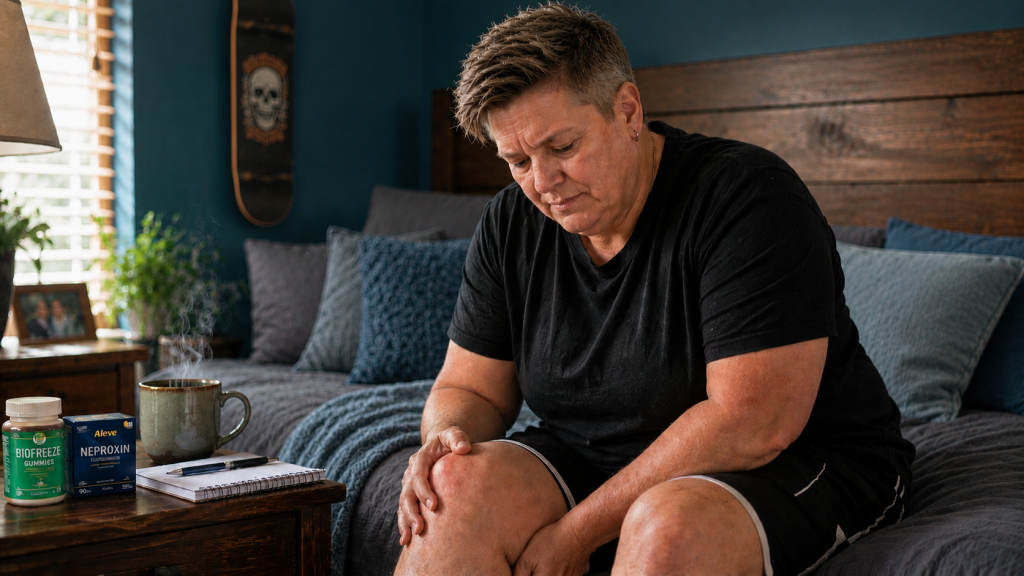
Both knees are bad. The left one is worse.
This is a combination of things. Old hockey damage from years ago that healed improperly or just wore in ways that compound over time. The natural deterioration that happens when you’re aging and you’ve put your body through its paces. And—and this is the part I’m not going to hedge around—weight. Carrying more weight than my frame and these joints handle well, for longer than I should have.
I’d say weight is contributing to maybe seventy-five percent of the current problem. The rest is injury history and age. Both of those I can’t change. The weight situation is more complicated, more gradual, and more within my influence than the other factors.
Walking is difficult on bad days. Some mornings I get up and I can feel exactly what kind of day it’s going to be from the moment my feet hit the floor. There’s stiffness that doesn’t resolve quickly. Discomfort that changes the way I move through space—shorter steps, more careful navigation of stairs, a hesitation before anything that requires impact.
I’ve lived with this long enough that some of it stopped registering as abnormal. That’s what chronic discomfort does—it normalizes itself. You adapt your life around it without fully acknowledging that you’ve adapted. You stop walking places you used to walk. You sit when you used to stand. You find workarounds until the workarounds become the default.
I’m naming this clearly because I think a lot of people reading this know exactly what I mean—and I don’t see it described honestly very often. Most content about knee pain and mobility is either clinical and detached or aggressively optimistic. Neither of those is where I am. I’m somewhere in between: clear-eyed about the problem, realistic about the work required, and tired of the status quo.
What I’ve Been Doing (Nothing)
Right now, my movement routine is: nothing.
No formal exercise. No structured stretching. No deliberate low-impact activity. Walking when I need to walk. Sitting more than is good for me. This is what years of chronic discomfort and a lifestyle that got progressively more sedentary produces.
This is not a proud admission. It’s also not a shameful one. It’s just where I am, and naming it accurately is the first step toward changing it.
I’ve had periods in my life of being more active. I’ve had periods where I was more conscious of movement and strength. I know the difference it makes. I’ve let those periods end and not reinitiated them, which is the pattern I’m looking at now.
The reasons are real: pain creates a disincentive to move. When movement hurts, the rational response is to move less. But less movement leads to weaker supporting muscles, which leads to more pain, which leads to less movement. It’s a loop that tightens quietly until you’re much further from functional than you realized you’d gotten.
I’m further from functional than I’d like to be. That’s the truth.
Why Low-Impact Movement Is the Only Realistic Starting Point
Here’s what I know about starting over with mobility when you have damaged joints: you don’t start where you think you should. You start where you actually are.
For me, that means low-impact. That means nothing that loads the knees with impact—no running, no jumping, no anything that requires landing on a hard surface with your full weight moving through already-compromised joints. That’s not defeatist. That’s physics.
What I can do:
Walking—carefully, gradually, on surfaces that aren’t punishing. The island has good surfaces for this. I have access to beach, which is softer, and to relatively flat streets. Short distances. Consistent frequency. Not intensity—frequency.
Water movement. I have the Caribbean. I have access to some of the most beautiful snorkeling water in the world, and moving in water takes significant load off the joints while still engaging the body. This is something I already love. This is something I’m going to use deliberately.
Chair-based and floor-based mobility work. Stretching. Strengthening the muscles around the knees—specifically the quads, hamstrings, and hip stabilizers—which takes pressure off the joint itself. This is foundational work that doesn’t require equipment and doesn’t require impact.
That’s the beginning. Modest. Deliberate. Consistent.
Weight, Honestly
This is the part I want to get through without either glossing over it or turning it into a self-flagellation exercise.
Weight is a significant factor in knee joint health. This is not opinion—it’s mechanics. Every pound of body weight exerts multiple pounds of force on the knee joint under load. For someone who is significantly overweight with already damaged joints, this is not a minor consideration. It’s central.
I’m not going to give you numbers because the numbers aren’t the point. The point is that I know—I have known for a long time—that my weight is contributing heavily to this problem and I’ve done very little about it consistently.
Part of this is the loop I already described: pain reducing movement, reduced movement contributing to weight, weight contributing to pain. Part of it is emotional eating that I understand intellectually but haven’t always managed well in practice. Part of it is living somewhere where food is social and joyful and the local cuisine is genuinely wonderful and moderation has not always been where I’ve landed.
I’m not starting a dramatic dietary overhaul. I’ve done that enough times to know that dramatic overhauls produce dramatic short-term results and then relapse. What I’m doing instead is starting to eat more deliberately. More consciously. Less reactively.
Less food that serves an emotional function and more food that serves a physical one. Not deprivation—I’m not built for deprivation and I don’t believe in it—but consciousness. Attention. Choosing what I put in my body the way I’m trying to choose everything else: with some awareness of what it’s actually doing for me.
What Rebuilding Actually Looks Like in Practice
Let me be concrete about what the beginning of this looks like, because I think concrete is more useful than aspirational.
Week one: Getting up from sitting at least every hour. Walking to the water at least once a day—not fast, not far. Starting. Just starting.
The first movement routine: Fifteen to twenty minutes in the morning before the heat sets in. Seated stretches for the hips and hamstrings. Slow knee extensions. Gentle quad sets—contracting the muscle, holding, releasing. This is not a workout. This is a conversation with a body I’ve been neglecting.
Water movement: At least two swims per week. The Caribbean is right there. Using it. Not just as background to my life—as active therapy.
Daily tracking: I’m going to track pain levels, movement, and what I ate—not obsessively but honestly. If I can’t see the baseline I can’t measure the change.
None of this is impressive. None of this is Instagram-worthy. But this is what rebuilding looks like when you’re starting from zero: not the progress photos and the before-and-after, but the moment before any of that, when you decide to actually show up for yourself in the least glamorous possible way.
What I’m Not Going to Do
I’m not going to pretend I’m twenty-five.
I see a lot of midlife wellness content that sort of winks at aging while actually presenting a fantasy of defeating it. People in their fifties doing CrossFit and hot yoga and triathlons with the implication that if you just try hard enough you can operate like a thirty-year-old with a thirty-year-old’s joints.

That’s not the game I’m playing. My knees are what they are. My age is what it is. The goal is not to reverse time—the goal is to function well in the time I have. To walk without wincing. To snorkel without dreading the getting-in and getting-out. To move through my days on this island with more ease than I currently have.
Functional. Not impressive. Functional.
I think that’s an honest and useful bar for a lot of us in midlife—especially those of us carrying old injuries or dealing with the real physical reality of aging bodies. We’re not competing with anyone. We’re trying to live well. Those are different projects with different metrics.
The Ongoing Series: What’s Coming
This is the first post in what’s going to be an ongoing series. I’ll be checking in on Patreon with more frequent updates—real ones, including the days when I don’t move and the days when moving hurt and the days when something shifts and I can feel it. The actual record, not the curated highlight.
Saturday Morning Coffee is where this will get discussed live. I show up every week with coffee and whoever wants to be there, and we talk about whatever’s real. Mobility and health and aging are going to be part of that conversation regularly from here forward.
The YouTube content is coming too—short pieces about specific exercises I’m trying, what’s working and what isn’t, honest check-ins on progress. Nothing polished. Just real.
What I’m building here—across all these platforms—is a record of someone in midlife doing the actual work of rebuilding. Not the inspirational version. The honest version.
If you’re somewhere similar, I hope it’s useful to see someone else in it with you.
Why This Matters Beyond Just Knees
Here’s the thing I want to say before I close this out.
Physical health and emotional health are not separate systems running on parallel tracks. They’re the same system. When I’ve been in relationships that depleted me emotionally, my physical health has suffered. When I’ve been sedentary and in pain, my mood and my mental clarity have suffered. When I’m not sleeping well because my joints are uncomfortable, everything else degrades.

This isn’t a metaphor. It’s literally how bodies work.
What I’m starting here—with knees, with movement, with deliberate attention to what I’m eating and how I’m moving—is not separate from everything else I’m rebuilding. It’s the same project. The same decision to stop waiting to feel better before I do the things that will make me feel better.
You can’t always wait for the right conditions. Sometimes you have to create them, imperfectly, starting from wherever you actually are.
I’m starting from here. From real. From the beginning.
Let’s see where it goes.
I’m tracking this whole process on Patreon—pain levels, movement logs, what’s actually helping, and what isn’t. If you want the honest ongoing record and not just the blog highlights, that’s where it lives. And join me for Saturday Morning Coffee every week—live, unscripted, and always real. Links below.

Leave a Reply
You must be logged in to post a comment.